
- What first led you to question the role of fragrance in skincare and body care?
I lost my sense of smell for 3 months in 2017. Thankfully it came back, but it was distorted (a condition called parosmia). I have always been someone who loves perfume and scented skin and body care, but when I got parosmia, almost all my bath and body products smelled terrible. I couldn’t use any of my favorite perfumes, and the only soap I could use was African Black Soap and Dove White Beauty Bar soap. I was already a body care and home fragrance formulator at that time. My business—Akiba Fragrance and Wellness Studio—made scented skincare and home care products designed to make people feel good. But now, I had to stop working with most fragrance materials because they smelled awful. I used to blend my own fragrances for my body butters and body oils—I had to put that on hold. Fragrance, the element that defined my business, was no longer something I could take for granted. During that season of my life, fragrance became the major factor that determined whether I could use a skincare or body care product. It would be about 3 years later that this experience would bring me to a turning point in my business—the decision to transition from formulating fragranced body care to fragrance-free body care.
- Many products claim to be “gentle” or “clean.” What do people often misunderstand about fragrance-free skincare?
Fragrance-free skincare is often expected to be without an aroma, and people are often surprised to find that fragrance-free skincare products may have a smell. Technically, "fragrance-free" means that a product was formulated without the addition of fragrance oils, essential oils, or any other ingredient intended to add a scent to the finished product—but the finished product will have the smell of the ingredients used. For example, a body butter made with shea butter and olive oil can be labelled "fragrance-free," but it will have a smell.
Secondly, "fragrance-free" does not guarantee that a skincare product will be “gentle” on the skin or "clean." Fragrance is only one component of a product formulation. The description of a skincare product as "clean" or "gentle" will also be determined by the other ingredients in the product, the process by which it was made, and its storage conditions, among others. People with sensitivity to fragrance may also have sensitivities to other ingredients in a product. So while “fragrance-free” indicates that one potential irritant has been excluded, a skincare product may still be harsh on the skin because of other ingredients in the formulation. These ingredients could be natural or man-made. Reading ingredient labels is very important, especially if you have fragrance sensitivities or sensitive skin.
- Your work also resonates with people experiencing fragrance sensitivity or parosmia. Why is this topic so important to you?
Fragrance sensitivity and parosmia are important to me because I have experienced both myself, as mentioned earlier. Knowing how these conditions affect one’s quality of life has given me a passion for helping others dealing with sensitivity to fragrance or distortions in their sense of smell
We tend to take our sense of smell for granted. We also take our ability to enjoy fragrance for granted.
When your sense of smell becomes distorted and you can no longer tolerate familiar and everyday smells that were a normal part of your life, you realize how important having a normal sense of smell is to your enjoyment of life. It’s not only about enjoying life, though; it is also a safety issue—imagine there is a gas leak in your house, and you are unable to detect it—that puts your life at risk.
In the case of fragrance—we all love a good smell, and wearing fragrance on your body or applying fragrance to your surroundings can make you feel good. Unfortunately for some people, fragrance has the opposite effect and may even be life-threatening.
In 2017, when I had my bout with smell loss and distortion, I knew only a handful of people who had a similar experience to mine. Then the pandemic happened, and there was an explosion in the number of people with smell loss and smell distortion. They also began to have difficulty using their regular scented personal care products. I read stories of people throwing their scented products away or spending money on products only to find that they couldn’t stand the smell. It was during that season that I decided to use my experience to help people experiencing smell distortion, particularly with regards to their body care needs. I decided to make body care products that would be safe for people with parosmia. I discovered later that there was an even larger community of people struggling to find suitable personal care products, not because of a sense of smell distortion, but as a result of fragrance sensitivity, and I widened my scope to cover them also. In 2021 I began the transition from fragranced body care to fragrance-free body care.
- For someone with sensitive or reactive skin, what should they look for when choosing body care products?
For sensitive or reactive skin, it is important to go beyond product claims to find out what ingredients are in a product. Reading and understanding ingredient lists is key. It is not enough that a product is labeled "fragrance-free" or "unscented." Unscented products may actually include fragrance added to mask the natural smell of the ingredients! Always check the ingredient list to make sure there are no ingredients generally known to be triggers or specific ingredients that you know you react to. Patch test new products before using them all over your body. Product reviews, if available, are a useful guide for choosing body care products. Experiences that others have had with a particular product can give an idea of whether it may be safe for your skin. Support groups for people with sensitive skin are also a great place to find product recommendations. Take time to research “body care for sensitive skin” brands you are interested in, and check for transparency about their ingredients and why they use them. Such transparency is an indication that the brand understands sensitive skin and has made deliberate choices.
- Akiba uses ingredients like kpangnan butter and nourishing plant oils. What makes these ingredients especially supportive for sensitive skin?
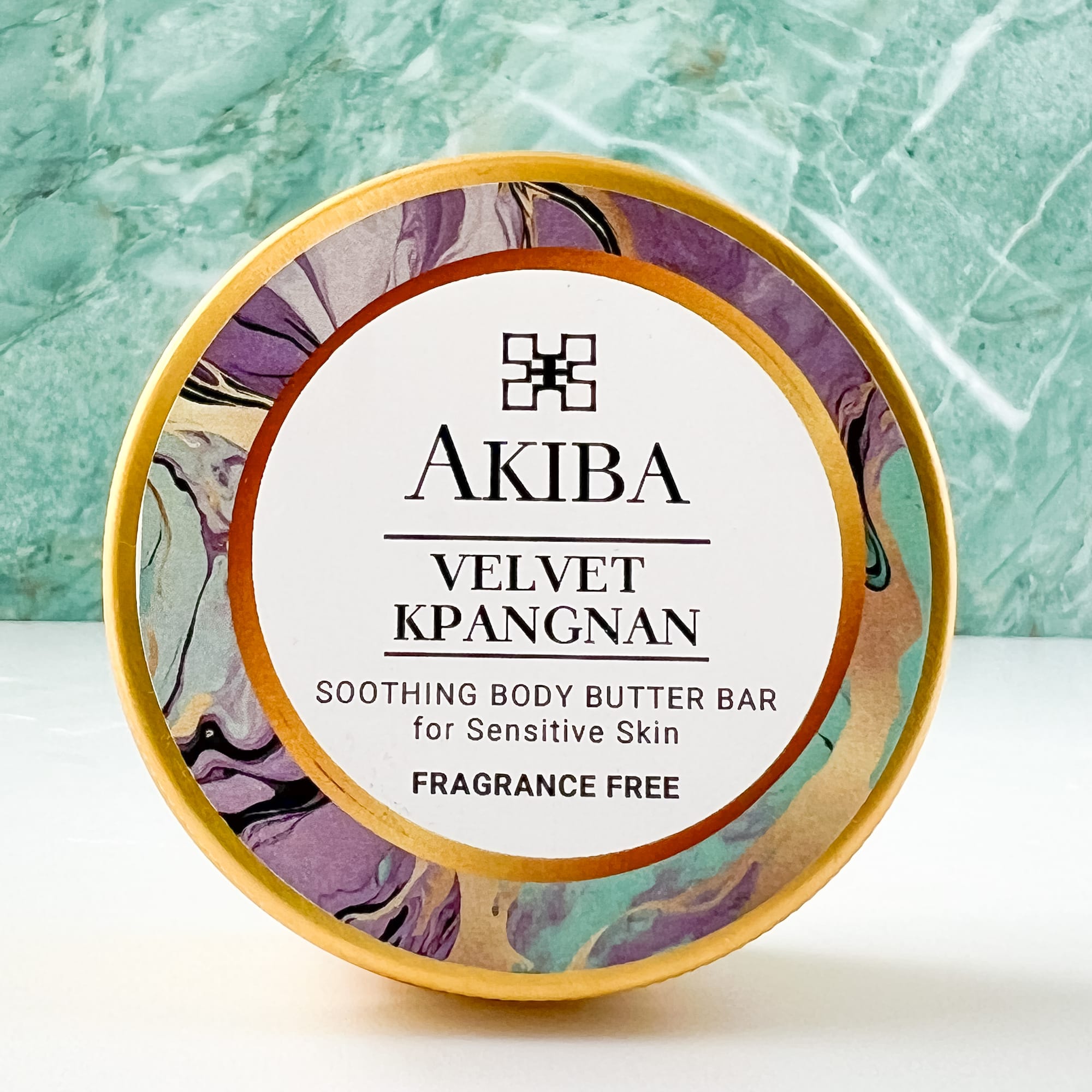
Kpangnan butter is our flagship foundation ingredient. It has a unique powdery consistency that imparts a soothing, velvety feel when used in products for the skin. It is a great moisturizer and has a natural scent profile that is non-irritating. We also use other butters, including mango butter, kokum butter, and cupuacu butter, and plant oils such as pequi oil and grapeseed oil. These butters and oils support sensitive skin in that they help the skin to retain water by strengthening the skin’s natural barrier, which may be especially fragile in persons with sensitive skin. They also have antioxidant and anti-inflammatory properties that help to protect the skin from environmental stressors and to calm irritated skin. Cupuacu butter, for instance, is well known for its water-holding capacity, while Kpangnan butter is known for its anti-inflammatory properties.

- For someone discovering Akiba for the first time, which product would you recommend starting with and why?
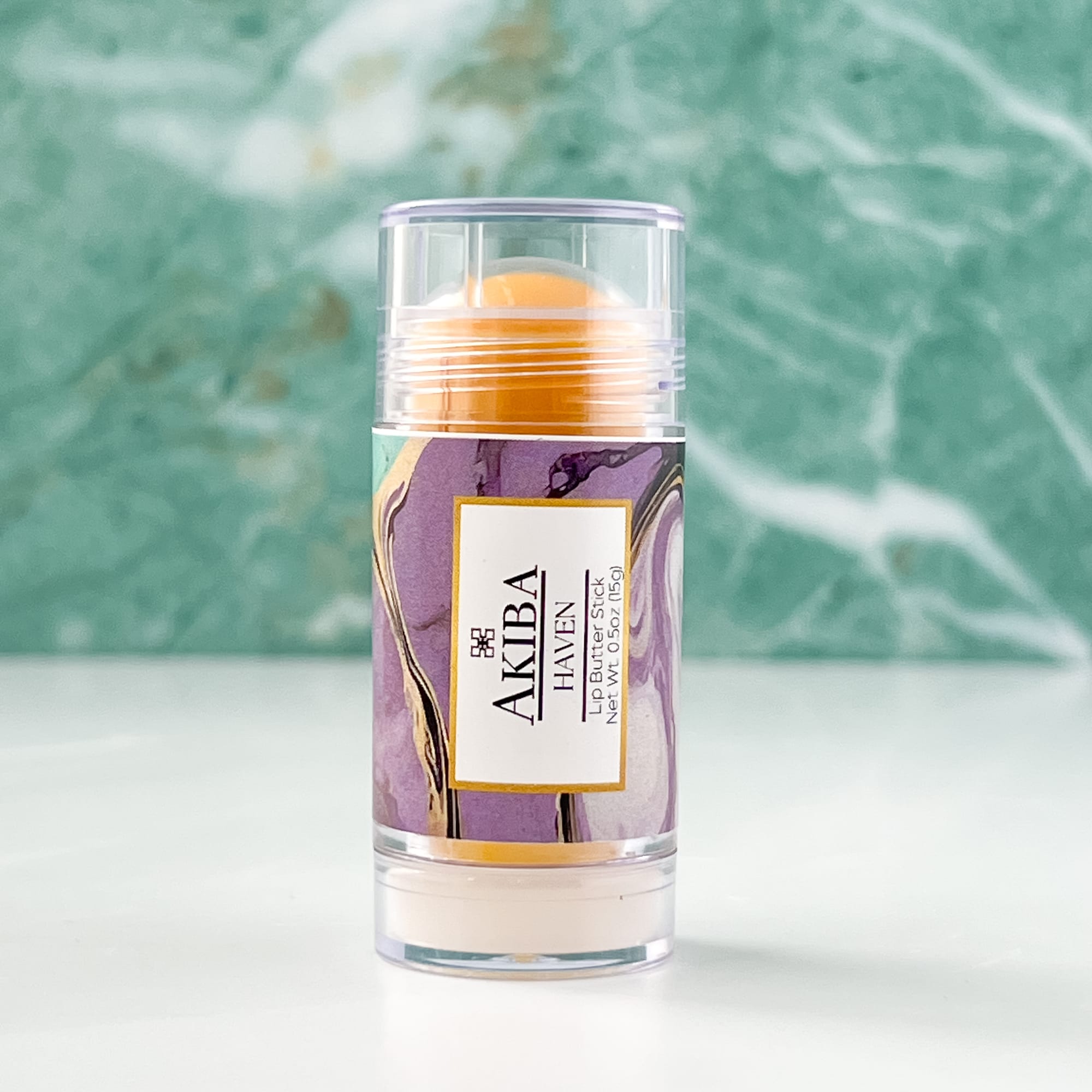
I would recommend starting with our fragrance-free “Haven Lip Butter Stick." For people with fragrance sensitivities, especially those who have tried several products labelled "fragrance-free" or "unscented" and have had an unpleasant reaction, our lip butter provides a simple way to try Akiba formulations without having to make a big investment. It is a simple formulation made of ingredients that most people recognize and that are gentle on the skin. It’s easy to carry and easy to use throughout the day whether one is at home, at work, or at play. And the best part is that it does a great job of keeping your lips soft and chap-free. One of our customers described it as “saving her life” because she has very dry lips and another said, “I use it everyday."
- What does “comfort as a standard” mean in the way you design your formulations?
At Akiba we formulate with fragrance sensitivity and sensitive skin in mind. Because of the adverse effects of fragrance on the senses and skin of people in this category, it is important that our products do not trigger discomfort (e.g., irritation, itching, headaches, breakouts) when used. Comfort as a standard means our formulations do not include ingredients known to be triggers for sensitive skin or noses; we do not use any fragrance oils, masking scents, or essential oils; we purposefully select ingredients that nourish the skin, and we formulate products that have a pleasant, comforting skin feel. We also select packaging for our formulations that is pleasing to the eye. To make up for the sensorial benefits missed by excluding fragrance, we create products that have tactile and visual interest. Our aim is that every Akiba product should feel safe and comfortable from the first use and every day after—we call it “care that feels good to keep."
- What do you hope people feel when they use Akiba products for the first time?
I hope people feel a sense of comfort, safety, and also delight. My hope, especially for people with fragrance sensitivity or sensitive skin, is that they feel like, “I found it! - I’ve finally found body care that is safe for me; it doesn’t irritate my skin or my nose, it doesn’t smell bad, it feels good, and it looks good too.